
Understanding Today’s Email Threats
When you open your inbox, how confident are you that every message is legitimate?
Email is the trusted backbone of modern business communication—it’s where invoices are approved, payroll is processed, vendors are managed, and sensitive information is exchanged every day.
Here’s the harsh reality you need to consider: email is also the number 1 entry point for cyberattacks.
With AI as a tool, phishing attacks are more powerful, business email compromise (BEC) scams are more convincing, and impersonation attempts more closely mimic executives, vendors, and even your own writing style.
Scams that used to look suspicious now look…normal. That’s what makes email security for business such a critical (and often underestimated) risk.
For many organizations, this isn’t just an IT issue. It’s a financial, operational, and reputational risk that can impact everything from cash flow to customer trust.
Why Email Remains the #1 Security Risk for Businesses
It’s easy to assume your business is protected. After all, Microsoft 365 or Google Workspace already includes security features, right?
Email remains the most exploited attack vector, and there are a few key reasons why. Think of your inbox like your company’s front door. Now imagine that door is open all day, every day, with hundreds of people knocking (some legitimate, some not).
Here’s why attackers keep targeting email:
Even with improved cybersecurity tools, email remains the easiest way for attackers to gain access to your business systems.
Beyond Basic Phishing
Let’s clear up one of the biggest IT misconceptions: phishing isn’t just poorly written emails with obvious red flags anymore.
Phishing Attacks Have Become More Convincing and Automated
Modern phishing attacks are powered by automation and AI, which means messages are grammatically perfect, branding looks legitimate, links redirect to realistic login pages, and emails can be personalized using publicly available data.
For example—an employee receives an email that appears to be a Microsoft 365 alert, asking them to “re-authenticate.” The page looks identical to the real login screen. Within seconds, credentials are captured.
Business Email Compromise (BEC) and Financial Fraud
BEC is one of the most financially damaging cyberthreats facing organizations today, and one of the most misunderstood.
Unlike traditional cyberattacks, there’s no malware to detect, no suspicious attachment to block, and often no obvious red flags. Instead, attackers rely on something far more effective: trust.
They study your organization and learn how your team communicates. Then, they quietly and convincingly insert themselves into everyday business processes.
Here’s how that typically plays out:
AI Impersonation and Spoofing Attacks
This is where things get even more concerning.
AI can now:
Combine that with domain spoofing (emails that look like they’re from your company), and you have a near-perfect impersonation.
This is why email threat protection must evolve beyond traditional filtering.
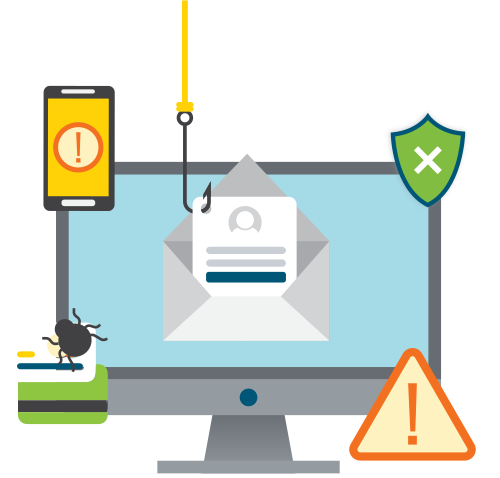
Where Does Email Security Typically Have Gaps?
Unfortunately, many organizations still rely on outdated defenses as their email security strategy. A few common gaps include:
These gaps create a false sense of security, which is one of the most dangerous IT misconceptions businesses face today.
The Role of Email Authentication: SPF, DKIM, DMARC Explained
Let’s simplify something that feels overly technical. The job of email authentication is to help answer a critical question: Is this email actually coming from who it claims to be?
Think of email authentication like a security guard verifying someone’s identity before letting them into your office.
As part of a risk assessment, we find that many businesses either don’t have these configured, only partially implement them, or don’t monitor them at all, which leaves the door open to spoofing and impersonation (two of the most common entry points for cyberattacks). If you have questions regarding your business’s email security, we can help—click here to get in touch with our team.
The Business Impact of Poor Email Security
When email security fails, the consequences go far beyond IT. One successful attack can cost more than your entire annual managed IT services cost—a reality many businesses only realize after the fact.
With poor email security, your business is at risk for the following:
5 Things You Can Do Today to Improve Your Email Security
The good news? Email security is a problem you can easily solve with the right approach. You don’t need to overhaul your entire IT environment overnight. In many cases, meaningful improvements to your email security come from a series of smart, layered decisions that work together to reduce risk.
Let’s walk through what that looks like in practice.
1. Add Layered Email Threat Protection
Relying on a single line of defense isn’t enough, and this is one of the most common IT misconceptions businesses face.
Modern email threats are designed to slip past basic filters. That’s why organizations are increasingly adopting a layered approach to email threat protection.
Defense-in-depth email security typically means going beyond default protections in Microsoft 365 or Google Workspace and introducing additional tools that specialize in identifying impersonation, credential harvesting, and business email compromise. Some solutions even monitor inbox activity directly through API integrations, giving you visibility into threats that traditional filters might miss.
Think of it like securing your office building. You wouldn’t rely on just one lock on the front door—you’d use multiple layers of protection to reduce the chances of something slipping through.
2. Strengthen Your Human Firewall with Security Awareness Training
Even the most advanced tools can’t stop every attack, especially when the final decision comes down to a person clicking a link or approving a request.
That’s why Security Awareness Training (SAT) plays such a critical role in business email security.
Instead of treating training as a one-time event, leading organizations build cybersecurity training into their ongoing operations. Employees participate in phishing simulations, learn how to recognize subtle red flags, and understand how to pause and verify requests that feel urgent or unusual. Over time, this creates a culture of awareness where employees aren’t just users of technology—they’re active participants in protecting it.
3. Improve Visibility and Speed of Response
When it comes to email threats, timing matters more than most businesses realize.
The difference between catching a malicious email in minutes versus hours can determine whether the issue is contained or escalates into a larger incident.
Improving visibility means monitoring email activity in real time, identifying suspicious behavior quickly, and acting before a cyberattack spreads. This might include removing malicious messages from inboxes, locking compromised accounts, or alerting users to potential threats.
The goal isn’t just prevention, it’s rapid response. The faster you can detect and act, the less opportunity an attacker has to do damage.
4. Get Your Email Authentication Configured the Right Way
Earlier in this blog, we discussed SPF, DKIM, and DMARC. These authentication protocols are foundational to strong email security, yet they’re often:
- partially configured
- misaligned across systems
- or not actively monitored
When set up correctly, email authentication protocols help prevent attackers from sending emails that appear to come from your domain. When misconfigured, they can create a false sense of protection.
This is one of those areas where “good enough” isn’t actually good enough.
Getting authentication right not only reduces spoofing risks—it also improves email deliverability and gives your business greater control over how your domain is used.
5. Partner with a Managed IT/Cybersecurity Provider
At a certain point, email security becomes less about individual tools and more about strategy. A trusted technology partner (like High Touch) can make a measurable difference.
A managed IT services provider can help you:
- continuously monitor your environment
- manage configurations like SPF, DKIM, and DMARC
- deploy and fine-tune advanced email security tools
- align your cybersecurity approach with your broader business goals
Instead of reacting to threats as they happen, you’re building a proactive, structured approach to risk management.
From a financial perspective, this solution often leads to more predictable managed IT services costs and lower long-term business IT costs (especially when compared to the impact of a single successful attack).

We Help Keep Your Business Safe.
Are you ready to start strengthening your email security?
At High Touch Technologies, we’ve spent over 40 years helping businesses navigate complex technology challenges with confidence.
Our managed IT services and cybersecurity solutions are designed to:
- help reduce risk
- improve visibility
- and protect what matters most—your business operations and data
If you’re unsure where your email security stands, get in touch with our team to schedule an email security review or request a cybersecurity risk assessment today. We’ll help you identify vulnerabilities, strengthen your defenses, and ensure your business is prepared for the evolving threat landscape.