
Mitigating Social Engineering Risks Across Your Organization
Have you ever received an email, text, or message that felt urgent enough to act on right away, only to realize later that something wasn’t quite right? If so, you know exactly how social engineering attackers operate before the damage is done.
Social engineering attacks rely on one thing above all else: human trust. Instead of exploiting technical flaws to break into systems, threat actors manipulate people into making mistakes, such as sharing credentials, clicking malicious links, downloading malware, or wiring money.
To illustrate how quickly social engineering can turn into a full-blown cybersecurity incident, imagine this:
As an employee at a growing health care clinic, you receive a message that appears to come from “Internal IT.” The email references a recent software update, uses the correct company signature block, and even matches the writing style of the help desk staff. The message claims you must “validate credentials to avoid system access interruption.” With patients waiting and deadlines pressing, you click the link. Within seconds, you’ve unknowingly installed malware that quietly spreads across the network.
With just one click, the attacker now has the foothold they need to access sensitive medical records, deploy ransomware, or move laterally across the environment. This scenario happened not because the business lacked strong firewalls or anti-virus tools, but because an attacker successfully manipulated you into opening the door for them. This is the essence of social engineering. For small businesses, nonprofits, and enterprise organizations alike, it remains one of the most damaging threats in cybersecurity today.
In this guide, we’ll break down what social engineering is, walk you through the most common types of attacks (including emerging AI-generated threats), and outline the strategies your organization can adopt to protect itself and its people.

Definition: What Is a Social Engineering Attack?
Social engineering is the use of psychological manipulation to trick individuals into revealing confidential information, granting access, or performing actions that compromise security. Unlike traditional cyberattacks that exploit software vulnerabilities, social engineering attacks exploit human emotion, including trust, fear, urgency, and curiosity.
Threat actors prefer social engineering because it’s often far easier to trick someone than to crack expert-designed cybersecurity systems. You can patch your firewalls and update your anti-virus, but employees can still be influenced and scammed.
Once an attacker gains access through social engineering, it often becomes the catalyst for broader incidents, including:
High Touch Technologies held a webinar titled “Tis the Season: Protect Your Organization From Social Engineering Attacks” on December 9, 2025. Watch the webinar recording above to learn expert insights on social engineering attacks.
3 Common Types of Social Engineering Attacks
1. Phishing
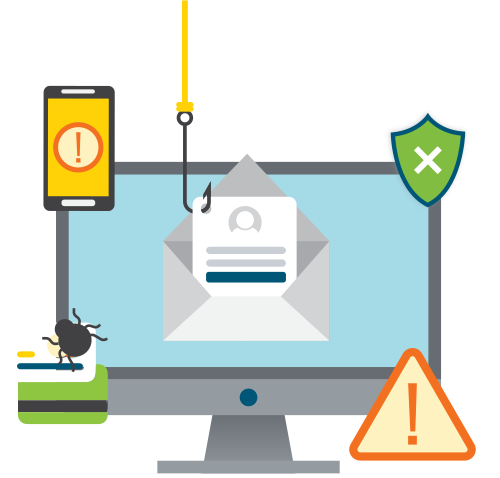
Phishing is the most common (and most successful) form of social engineering. In phishing attacks, cybercriminals impersonate trusted individuals or organizations and send fraudulent emails, texts, or voice messages to trick users into sharing sensitive information or clicking malicious links.
Phishing works because it taps into powerful psychological triggers, including urgency (“your account will be deactivated”), authority (“this request comes from IT”), and fear (“your password has been compromised”). High-quality phishing attacks don’t look sloppy. They look legitimate, well-written, and tailored.
With AI entering the picture, phishing attacks are becoming even harder to spot.
Consider this example:
In this hypothetical scenario, a financial services employee receives a Microsoft Teams message appearing to be from their IT administrator. The message requests urgent “identity verification due to unusual login activity” and directs the user to a webpage that looks identical to their real login screen. The employee enters their credentials, unknowingly handing the network keys directly to an attacker.
Manipulation Tactics: Baiting, Pretexting, and More
Small moments can have a big impact. Attackers use a wide range of manipulation tactics to deceive users into acting against their own best interests.
Baiting involves offering something enticing to lure someone into a trap, such as a USB drive labeled “Payroll Records” left in a break room or a free software download containing malicious code.
Pretexting involves creating a fabricated scenario to gain trust. An attacker may claim to be a vendor, customer support agent, or third-party auditor needing “urgent access” to an account. They rely on appearing knowledgeable and credible to extract information.
Other manipulation methods include:
Here’s a real-life example of a common manipulation tactic:
A nonprofit finance director receives a call claiming to be from the organization’s bank. The caller uses correct account details (previously obtained from reconnaissance) and requests verification to prevent a freeze on outgoing grant payments. Believing the request is legitimate, the director shares login information, giving the attacker direct access to the organization’s financial portal—yikes.
Malware, Ransomware, and Data Breaches
Social engineering is often the first domino in a chain of destructive events—it’s not just a cybersecurity issue; it’s a business continuity issue.
An attacker convinces someone to open a malicious attachment. That attachment installs malware. Then, the malware creates a backdoor that enables ransomware deployment, data exfiltration, or full network takeover.
This chain reaction is exactly why social engineering is one of the most dangerous cybersecurity threats for businesses.
One employee falling for one message can result in:
Emerging Treat: AI-Assisted Social Engineering
Artificial intelligence has helped elevate the sophistication of social engineering to unprecedented levels. Attackers now use advanced tools to create compelling, highly personalized messages that were nearly impossible to produce at scale just a few years ago.
Deepfake Voice Calls
Attackers use AI voice cloning to impersonate executives, physicians, or financial officers. Imagine receiving a voicemail from your CEO, using their exact voice, requesting an urgent wire transfer. This is no longer theoretical—it’s happening to businesses across the globe.
AI-Assisted Phishing Emails
Typo-riddled scam emails are a thing of the past. With generative AI, attackers can craft flawless emails that mimic internal communication styles, reference real projects, and appear fully authentic.
Fake Internal Messages
With a bit of reconnaissance, AI can generate Slack, Teams, or SMS messages that mimic your coworkers’ writing style, including personalized details scraped from public information.
Future Threat Forecast
As AI continues to accelerate, social engineering will evolve into even more adaptable and targeted manipulation. Strong cybersecurity tools remain essential, but human-focused defenses will be more critical than ever.
Organizations must plan now for:
Why Social Engineering Is Especially Dangerous for Businesses
How To Defend Your Business Against Social Engineering Attacks
Social engineering is especially dangerous, because you can’t eliminate the risk entirely—however, with the right combination of training, technology, and preparedness, you can help your organization significantly reduce its risk.
Build a Culture of Cybersecurity
Employees are your business’s first line of defense. Building a strong culture of cybersecurity awareness helps ensure employees are educated to detect and respond to cyberthreats. To build a culture of cybersecurity, we recommend:
Test Often and Have an Incident Response Plan
Being prepared for a social engineering attack is essential. Every organization should have a well-documented testing and incident response plan, including:
We Help Keep Your Business Safe.
Social engineering isn’t a fringe issue—it’s one of the most common (and costly) cybersecurity risks facing businesses today. As attackers adopt AI-powered tactics, these threats will only become more sophisticated.
At High Touch Technologies, our goal is to help organizations stay one step ahead by strengthening both human and technical defenses. From Security Awareness Training and cybersecurity assessments to secure Managed IT Services, we act as your technology partner to help you create a safer, more resilient environment for your team and your data.
If you’re unsure where your vulnerabilities may be, or if you want expert guidance in building a comprehensive cybersecurity strategy, our team is ready to help. Contact us today to see how we can help strengthen your organization’s defenses.